From AI Hype to Category Impact: What Generative AI Really Changes for Category Teams
.png)
The acceleration of generative AI has come with a fair amount of noise: overpromised capabilities, confusing terminology, and tools that don't quite deliver on the pitch. For category teams trying to cut through the hype and figure out where AI fits into their work, the confusion is frustrating.
The Hype Cycle Is Real and Predictable
Most early generative AI tools are variation of a ‘chat with your data’ function. Ask a question in plain language, get an instant answer. For category teams drowning in data, this is an incredibly helpful capability that saves time.

Once teams could get answers faster, the natural next questions became:
- Can AI do the deeper analysis, too?
- Can it explain why sales dropped in a particular region?
- Can it recommend what to do about it?
This is where many organizations have hit a wall. Teams are asking AI tools to perform tasks they weren’t designed for.
Understanding that there is a ‘right AI’ for the ‘right job’ is the most valuable thing category teams can learn about AI right now.
Three Ways AI Shows Up in Category Work
Rather than thinking about AI as a single capability, it helps to think about it in terms of what you're trying to accomplish. In category management specifically, AI tends to show up in three meaningful ways:
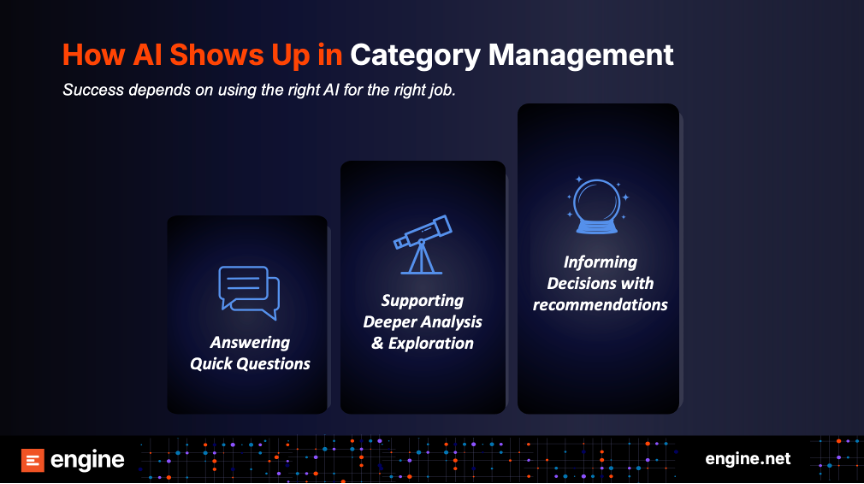
1. Answering Quick Questions
This is where most teams start, and where generative AI shines. Natural language tools, like RetailGPT, can translate a question, "Show me velocity trends for energy drinks in the Southeast" into a query and return an answer in seconds saving the 30+ minutes it would ordinarily take for an analyst to reach the same answer. This capability is valuable for asking ad hoc questions during a buyer meeting or a quick gut-check before a presentation.
The caveat is that this type of AI retrieves and summarizes information. It doesn't interpret what that information means strategically. That interpretation still belongs to the category manager.
2. Supporting Deeper Analysis
The next level is where more sophisticated AI becomes genuinely useful. Complex category questions like, "Which categories have shown sustained growth over three years, and how does that correlate with inventory turnover?" typically require 20 or more manual queries, cross-referencing data from multiple sources, and significant synthesis time. Multi-step AI agents, like Deep Research, can work through that kind of analysis the way a skilled analyst would, just much faster.
Teams using this type of AI have cut performance review timelines from days to hours. AI can surface the patterns, but deciding which patterns matter and building the business case around them is still a human job.
3. Proactively Informing Decisions
This is where AI moves from reactive to proactive, and where it starts to have considerable business impact. Category teams can't manually monitor every metric for every item across thousands of stores. Nuanced shifts in pricing, shelf space, or sales velocity often go undetected until revenue has already been affected.
One example from Engine’s work with a national snack manufacturer illustrates this well: Auto Insights detected a sudden sales decline across more than 230,000 points of distribution. Root cause analysis identified two distinct factors: a significant price increase tied to a measurable drop in sales, and a reduction in shelf capacity that correlates with a separate sales decline. By surfacing those findings automatically, the team was able to quantify the business impact and respond quickly, rather than discovering the issue weeks later in a monthly review.
What still requires human-led decision making is which corrective actions to prioritize, negotiation with retail partners, and executing changes. AI flags the problem and frames the situation. Category teams do the work that requires judgment, relationships, and context.

What This Means for Your Team
A few practical tips for category teams navigating AI adoption:
Start with the problem, not the technology. The most common mistake isn't failing to adopt AI but rather adopting AI before clarifying what question you're trying to answer. "What do I need to know?" should always precede "What can AI do?"
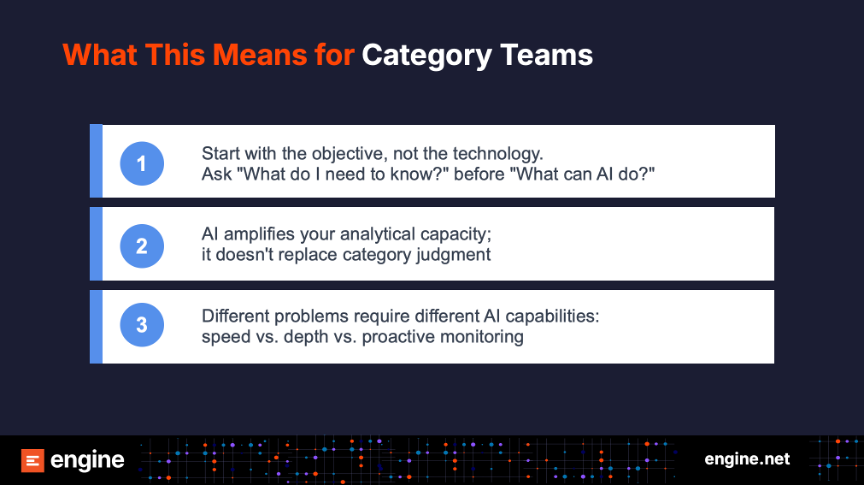
Match the tool to the task. Speed tools are not analysis tools. Analysis tools are not monitoring tools. Frustration almost always comes from applying the wrong capability to the wrong problem, expecting a Q&A tool to do deep root cause analysis, or for an analytics platform to catch anomalies in real time.
AI amplifies judgment; it doesn't replace it. The category managers who will be most effective with AI are the ones who remain deeply invested in their own expertise. AI accelerates the analytical work. Strategic thinking, such as understanding your shopper, your retail partner's priorities, your category's trajectory, is still the job.
--
The AI hype cycle creates pressure to move fast and adapt broadly. But the category teams getting the most value aren't the ones who are using AI the most, they're the ones being deliberate about which AI they use and why.


